Showing posts with label textile art. Show all posts

Tuesday, January 22, 2013

Eduardo and Maria Portillo

Detail of Nocturno
Nocturno
Yesterday I received these images by email from the extraordinarily talented Eduardo and Maria Portillo, and they quite frankly, made my heart skip a beat. The images show their work that is in a current exhibition 'Azul Indigo' in Caracas celebrating their exquisite use of indigo dying. But its not just about dying: the weave structures and dramatic yarn combinations take the colour exploration to another level. The work is utterly absorbing both from afar and up close: I love the way the ordered grid structure ripples, undulates and surprises as a result of the different yarn characters. 

The artworks aim to capture the various shades of blue that take us through the day; from the inky midnight blue sky, to a sky laden with rain, to the transparent air of the afternoon tinged with golden sunlight.

The exhibition is on until the 27th January. Sadly I won't be able to indulge myself with a trip to Caracas, but should you be nearby, you must go and savour this exhibition.... 


Detail of Nubes

En la Noche 

Detail of En la Noche 
Al Amanecer
Detail of Al Amanecer

Detai lof La Noche


The artists image reflected in an indigo dye vat


UPDATE, 15th March 2013
Here is some text that Eduardo and Maria have sent me translated from the catalogue that accompanies the exhibition. Enjoy.....

 
A Blue Journey
by María Dávila & Eduardo Portillo

Blue, color of multiple meanings, is also the color of hope. Every day dawns and the blue accompanies us in the sky, in the sea and in the distant mountains.

We see the blue in the morning but  in the  afternoon shows transparent with yellow and white. At night it darkens and with the moonlight follows a blue air. With the stars, in the morning, when it's almost dawn, the blue is still there.

Ten years ago, in 2002, when we found the indigo blue and draw travel lines to see the color of the peoples of Southeast Asia, of  the desert´s blue men , the Andean textiles and blue jeans, the eternal blue.

Indigo is obtained from various plants containing "indican" and Indigofera tinctoria L is the most used. As it is  insoluble in water, requiring an alkaline medium and a reducing agent to become soluble. When the vat takes an amber appearance, the fiber is immersed there, extracted  and with the air contact indigo oxidize to become  blue color.

In ancient times, due to its complex preparation process, the indigo vat was restricted to the hands of specialists. Its transformation from yellow-green to infinite variety blues was full of  magic and rigor.

In Venezuela still grows wild the indigo plant which was the base of an important industry for the country in the late eighteenth and early nineteenth centuries.

In the highlands of Mérida there remains the memory of using this dye in wool blankets.

The discovery of synthetic indigo in 1880 revolutionized the way to obtain the blue in the world, in a few years replacing the use of natural indigo.

Today indigo culture remains in traditional communities in Asia, Africa and Latin America and in a wide universe of contemporary artists who see in its process a synthesis of history, culture and life.

In the mountains of southwest China, where the golden evening light bathes their endless   and steep terraces planted with rice, Dong people wears blue, almost black, their cotton fabrics dyed in indigo that seems to become waterproof paper after going through a slow and fascinating process of immersion in the juice of some plants and systematic exposure to the sun.

In northeast Thailand, indigo is full of superstition and alchemy. In every home the recipe for its preparation is different, secret ; add brown sugar, pineapple, tamarind, liquor, prove it, smell it, they keep it "alive". There all hands are blue; for a moment everything is blue.

In southern India still there are some indigo plantations, where the rhythmic "dance" of blue bodies in pools of indigo oxygenates the obtained extract , which should be processed until the dye is achieved.

In the Andes, in Africa and Japan, the art, study, research, trial and error are present in every indigo vat. To travel in search for Indigo  could be itself  a motive for a lifetime, every "vat" is different, each vision is unique, we  decided to try to find our own blue. After this intense experience, we interlaced the blue with our searchs and then brought them into the loom.

After a necessary pause we have resumed the pleasure found years ago, exploring the art of indigo dyeing, immersed in their vats again and over again, and we brought it to textiles structures that move us to get closer to blue moments of everyday: the night, the moon, the sky, the clouds, dawn, dusk, moments of everybody, moments filled with blue.

We have tried to fuse into the blue  the silk from Mérida, moriche palm from the Orinoco river´s delta, the wool of the Andes, and cotton, dyed in indigo and complementing it with other natural sources of color (cochineal, eucalyptus and onion) and with metallic yarns.

The space is constructed using blocks and mosaics born from triple weave , which is based on the interlacement of three layers of warp yarns advancing simultaneously and independently  while is weaving each one of them, therefore it should be weave three times the length  of the fabric obtained.

The various combinations of blues are revealed by Taqueté, an ancient textile structure , based on the sequences of  three or four colors yarn groups in the weft or in the warp

Today we celebrate the encounter, a blue vision of the world, a vision about the universal indigo blue, navigating the collective imaginary of some moments of the day and we endevour to get them into the space of the wide textile world.-

Dec 2012

Tuesday, October 30, 2012

Linda Green


I first saw Linda Greens work at the brilliant Follow a Thread exhibition at Ruthin Craft Centre. It was one of the best exhibitions I'd ever seen celebrating textiles, which saw me visit and revisit the show time and time again. One of the bodies of work that kept drawing me back was the exquisite 'Exploring Structure' series by Linda, a tapestry graduate of the Royal College of Art and Edinburgh College of Art.

A series of 21 miniature woven studies were created on pieces of found wood, shells and other ephemera upon which the textile remained. It's a delightful depiction of the fact that to weave, you just need 'something' to hold your warp threads taught, for you to then interlace the weft over and under. I love the fact that the 'loom' is not only a functional tool, but an imperative part of the resultant textile artwork. The series was displayed in a linear landscape arrangement, propped up on a shelf against a wall, and the pieces seemed to just dance from one to another. The tiny scale commanded you to look closely and appreciate the minutiae of the fibre and yarn surface in a way that you'd otherwise overlook.


The exhibition toured to Dovecot after it left Ruthin Craft Craft Centre, and you can see some more images of Linda's work in situ, as well as some of the other exhibits on the Innovative Craft Flickr photostream

Sunday, September 30, 2012

Ismini Samanidou, Crafts Study Centre


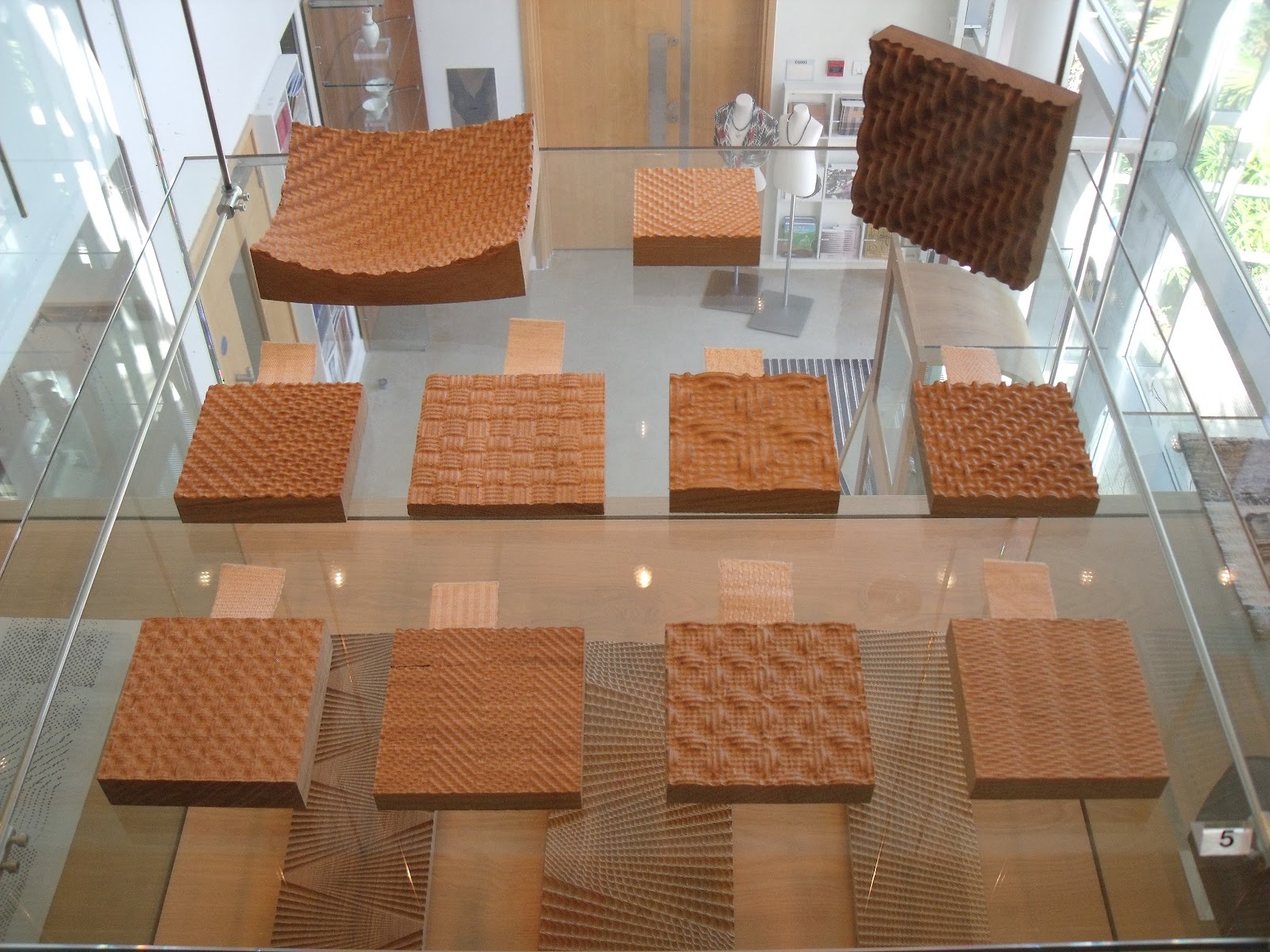
My blogging and exhibition visiting activity has been somewhat curtailed in recent times due to me very happily becoming a Mum. However, at the beginning of September I was delighted to be able to stop at the Craft Study Centre in Farnham en route home from Canterbury, to visit Ismini Samanidou's solo exhibition entitled Topography: recording place - mapping surface. Now extended until the 6th Oct, the show is absolute treat, giving an insight into Ismini's design process as well as presenting intriguing jacquard woven lengths. I always relish the opportunity to see samples, design sketches, mood boards, colour studies, yarn wraps etc, as they demonstrate pure, instinctive exploration that has yet to be synthesized into the 'final' work. The wall of cloud study samples was perhaps my favourite part of the exhibition for this very reason. Structural explorations of diverse surafce qualities in unusual yarns on the dobby handloom made a very welcome compliment to the jacquard woven artworks which I am so familiar with. It was also a delight to see her handmade fan reeds which were made whilst on a British Council residency in Bangladesh. These were used to weave some exquisite fabrics, which you can see alongside.

So, I urge you in the few days left to catch the exhibition before the work travels to the Center for Craft Creativity and Design in the USA. There is also a beautiful and insightful catalogue to accompany the show.

wisteria, momijigari, siberia and thread installation

'Cloud weavings'

Siberia lengths and cloud weavings

Watercolour and yarn wrap colour study

Hand woven fabric of varying density

woven interpretation of the texture photographs
 
Hand made fan reeds

Hand made fabrics woven with the hand made reeds

CNC routed wood replicating woven surfaces

Saturday, January 7, 2012

Ptolemy Mann, Ruthin Craft Centre

There is a truly sumptuous feast for the eyes exhibition at Ruthin Craft Centre which will be closing on the 15th January, so I urge you to go see this wonderful celebration of Ptolemy Mann's work in the primary gallery space whilst you can.

Ptolemy is one of the leading woven textile artists working in the UK at the moment, renowned for her ikat colour satuated artworks which adorn the walls of numerous public and private spaces. In recent times she has developed her signature style into digital prints which have opened up a whole new commercial avenue for her to exploit.  The exhibition presents these digital prints as fabric lengths, garments, furniture upholstery and cushions, alongside her handwoven ikats, and also her rug collaborations with Christopher Farr.  There are also some framed prints of her architectural colour facade designs.

Woven rugs on wall and floor - a collaboration with Christopher Farr


New hand dyed & handwoven ikats stretched over circular frames

I covet this sofa by Kristian Stringer upholstered in jacquard woven ikat effect fabric by Ptolemy

Detail of tufted rug
If you can't manage to visit Ruthin to see the show, you can order a catalogue direct from the gallery.


These pictures are all from Ptolemy's blog 'Significant Colour' which she started writing last year. Its a fantastic blog which I thoroughly recommend subscribing to.  She is generous in sharing her inspirations, preoccupations and thoughts about her all consuming passion for colour in all its guises.

Wednesday, August 31, 2011

Dani Marti


 Cast concrete Sydney, Australia Westfield, Urban Art Projects, John Wardle Architects & Mark Llewellynn Photography

 Cast concrete Sydney, Australia Westfield, Urban Art Projects, John Wardle Architects & Mark Llewellynn Photography

 Cast concrete
Sydney, Australia 
Westfield, Urban Art Projects, John Wardle Architects & Mark Llewellynn Photography
 
 Cast concrete
Sydney, Australia 
Westfield, Urban Art Projects, John Wardle Architects & Mark Llewellynn Photography

 Cast concrete
Sydney, Australia 
Westfield, Urban Art Projects, John Wardle Architects & Mark Llewellynn Photography
Beige, 2008
Nylon, polyester,leather & rubber on wood
260 x 190 x 14 cm


Beige, 2008, detail
Nylon, polyester,leather & rubber on wood
260 x 190 x 14 cm


George, 2001
polypropylene, nylon and polyester on wood
200 x 610 x 8 cm


George, 2001, detail
polypropylene, nylon and polyester on wood
200 x 610 x 8 cm

       Here's another example of me thanking the wonders of Google. A couple of weeks ago my mind wandered and I found myself googling images of 'extreme weaving' (yes, I know, I'm a weave nerd)...... and up popped a picture of the cast concrete images you see above. A big WOW moment.

Dani Marti is an artist producing woven panels of huge scale. Ropes, braids, strips of leather, rubber and chains are woven into giant twills, hopsacks and tabby structures. I long to see this work in the flesh, as I'm sure the impact must be utterly striking. The colour, textures and pure graphic impact of these panels is really exciting.  However the translation of these qualities into cast concrete is just brilliant. I love the idea of bringing the artisan, hand made textures into the architectural environment, and the huge scale of these familar surfaces must garner a huge level of curiousity.

Please do visit Dani's website - there are so many wonderful images to look through. For those of you in Australia, there is a solo exhibition coming up at the Newcastle Region Art Gallery opening on the 17th September until the 13th November.

Sunday, August 7, 2011

John Paul Morabito

Plain Weave with Stripes 2009
Wool, weaving, burning, 84" x 45". Photo credit: Nick Ghiz


Plain Weave with Stripes (detail) 2009
Wool, weaving, burning, 84" x 45". Photo credit: Nick Ghiz

Strip Construction (detail) 2010
Silk, rayon, weaving, burning 33" x 69". Photo credit: D. James Dee
 
Tonal Warp Stripe 2010
linen, ramie, weaving, burning 96" x 27" x 23". Photo credit: D. James Dee

Tonal Warp Stripe (Detail) 2010
linen, ramie, weaving, burning 96" x 27" x 23". Photo credit: D. James Dee
 
Two Block Float Weave, 2009
Silk, weaving, burning 83" x 8" x 6". Photo credit: D. James Dee


Two Block Float Weave (detail) 2009
Silk, weaving, burning 83" x 8" x 6". Photo credit: D. James Dee
 John Paul Morabito produces beautifully woven cloth that he then begins to destroy through carefully applied burns and scorches.  I've only seen the work online and in print, but I long to see it in the flesh: there is a real poetry in the presentation of the work which I find quite absorbing. The work appears hung eloquently within space, which emphasises the handwoven delicacy of the fine threads. I also find myself wondering if any 'burnt cloth' smells remains.... I hope so.

In his own words:

I am interested in hand labor. Hand processes manipulate materials to create both form and content in my artwork. I begin at the loom, building cloth line by line. Once woven, the work is destructed either through an immediate intervention or a slow, mediated process. In all cases, the cyclic relationship of creation and destruction is at the heart of the work.  

Of late my work has concerned itself with the actions of hand weaving and systematic burning. The process of weaving cloth by hand and then repeatedly burning it is an act of creation juxtaposed with an act of destruction. This sacrifice of cloth woven by my own hands is not a violent act. It is rather a quiet meditation. The holes are not burned quickly with ravaging flames. Instead each hole is made individually and slowly to create a contemplation of each moment that has been burnt away.  

Inherent to this work is the compulsory behavior of the obsessional. I am particularly interested in how this behavior relates to the death drive and it is this thanatological compulsion that is the impetus of the work.

Perhaps left over from when we first realized our mortality, we have built into us a yearning for all things impermanent. To be human is not only to create but also to destroy. Called Thanatos, the death drive draws us to the end. I find myself in some ways ruled by Thanatos. There is a need to make and a need to destroy, neither can be ignored.  

The hand that makes is the hand that destroys.