Saturday, June 11, 2011

Wallace Sewell


Wallace Sewell designed this moquette fabric for the London Overground fleet of new trains starting service in 2010. A dream commission for any textile designer, this project was perfect for designers Emma Sewell and Harriet Wallace-Jones who are well known for their use of colour and geometry in their range of scarves, throws and cushions.


Building on this association with Transport for London, they were recently commissioned by the London Transport Museum to interpret the moquette pattern as a dobby woven chenille throw. As with all the Wallace Sewell products, the throw is made in the UK. Its woven in 50% wool and 50% cotton chenille and you can buy it online at the London Transport Museum shop.


Tuesday, June 7, 2011

Action Weaver

http://latestaction.tumblr.com/
The Action Weaver (also known as Travis Meinolf) is a weaver after my own heart. He's literally taking weaving to the streets, and spreading the word about the weave revolution :-)

He hit my radar earlier this year when I heard he was part of the Curious About Craft? programme of events organised by the inspirational Craftspace in Birmingham. He was then serendipitously on BBC Radio 4 Midweek with Libby Purves talking about his work, when I was driving to college one day. (I was thus a little late for my students, as I HAD to listen to all of his interview.)  I urge you to listen to the Radio 4 programme as its just wonderful to hear him talk about his philosophies and ambitions for the weave revolution. Likewise I'm not going to try and precis his elegant words about his work: just follow the link and enjoy.

Public weaving in Berlin 2010

Public weaving in Berlin 2010

ArtyFun at the apartment
Image shows one of his 'laser looms', a rather wonderful updated version of rigid heddle back strap weaving
 
ArtyFun at the apartment

Mauer Park 4th July 2010 public weaving

I absolutely LOVE what he's doing..... it's one of those projects that I wish I had thought of ;-)  However I think its effectiveness stems from the fact that he doesn't come from the usual textile background: its all about the performance and the 'art' of the process that maybe we overlook.

All pictures are from the Action Weaver Flickr photostream..... head on over to lose a couple of hours flicking through them all :-)

GEGD8V4D7EPX

On tenterhooks......


Ever wondered where the phrase 'on tenterhooks' comes from? Once woollen cloth has been woven it needs to have the natural oils present in wool washed out.  After the cloth has been washed it needs to be stretched over a frame so that the cloth dries straightened, uncreased, in a uniform fashion: ie so that the width of the cloth is consistent throughout its length. In times gone by, it would have been a common sight in areas where woollen cloth was produced to see fields full of the wooden ''tenter' frames with wet cloth stretched and held in place by the metal hooks, drying in the air.

I took these pictures a little while ago at the National Wool Museum in Wales: a fabulous illustration of this principle which greets visitors as they arrive.

Monday, June 6, 2011

Solva Woollen Mill, Pembrokeshire


Solva is without doubt one of the prettiest villages in Pembrokeshire. For some obscure reason, despite being a Pembrokeshire girl (but now living 'away') I'd never got around to visiting Solva Woollen Mill. I don't know why, and being a committed weave-nerd, it makes me feel a little daft. So last week, I was back in the county with a little time on my hands and having read about the mill's newly renovated shop and tearooms that opened in Easter, I made the journey.

And wow, what a fantastic new space the owners Tom and Anna have created. I thought they must have commissioned a specialist retail/interior designer, but no its all Anna's work: she was a nurse in her previous life but clearly has an astute eye for design. The shop looked contemporary but visually told the story of the mill heritage by cleverly using lots of the old mill paraphernalia to display the stock and decorate the space. That's was me sold :-)

The mill specialises in flat woven rugs and stair runners. Most of the products are woven in 100% British wool that is dyed to their specifications. Aside from the stripes and checks, I particularly loved the traditional Welsh double cloth 'tapestry' rugs. The iconic motifs are familiar on bed throws but look surprisingly striking and contemporary in the chunky hard wearing wool for the floor.

They also weave a very elegant honeycomb/waffle fabric for blankets and cushions in a lovely charcoal or pea green colourway.

All lovely stuff. I highly recommend a visit........


Monday, May 30, 2011

Kelly Benjafield

I met Kelly Benjafield when I was a visiting tutor for a term at Nottingham Trent University back in 2009. It was the Autumn term and she was at the beginning of her final year. She has a wonderful quirky personality so I was really keen to see what she was going to end up producing for her final degree show exhibition. Such are the joys of the internet, from following a couple of random links I recently found myself at her blog and she has very kindly given me permission to share these images of her degree show with you here.

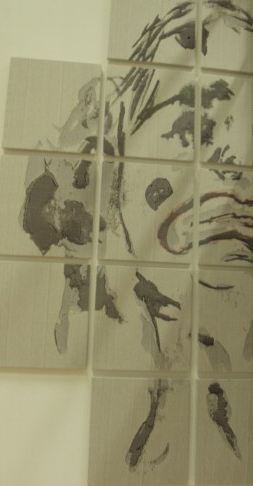
A pen and ink self portrait of herself entitled 'Sad Clown' was transformed into a jacquard woven composition of 13 panels in total measuring 6x4 foot. The fabrics were embroidered to add detail, then stretched over frames. I really admire the offbeat nature of her work: so not what you'd expect from a weave graduate. Not sure what she is up to now, but hope she manages to keep going with the weaving as there is real potential to push this idea further.

The original ink drawing


Detail showing the embroidery


The whole composition


Friday, April 22, 2011

'The Mill: City of Dreams' @ Drummond Mill, Bradford

(C) http://www.timsmithphotos.com/
Last Saturday I had the privilege of seeing the final performance of 'The Mill: City of Dreams' by Freedom Studios a wonderful 'promanade' play at Drummonds Mill in Bradford. The play was the culmination of a significant oral history project, collecting the stories and reminiscences of the mill workers of Bradford that came from all over the world on the promise of a better life.

It was without a doubt the most powerful piece of theatre I've ever seen. Admittedly, I'm probably the dream audience: if its got anything to do with weaving, then the likelihood is I'm going to enjoy it. However, I do also have a short patience threshold, particularly with drama, whether it be a film, TV or theatre: if the dialogue or plot is poor, then I'm unforgiving.

Without realising it, my partner and I had the ideal prelude to the play. We arrived in Bradford mid afternoon, and decided after checking into a shiny new hotel that we'd have a wander around the city and soak up the atmosphere. Despite being impressed by the National Media Museum and admiring the many listed buildings that litter the centre, we were also overwhelmed by the number of empty shops, and just how quiet it was for a Saturday afternoon in contrast to the crowded streets our home city of Cardiff. This was clearly a city suffering the loss of industry.

The Mill: City of Dreams, opens with a property developer revealing his plans to develop the empty mill into luxurious flats and leisure facilities. A power cut forces him to leave and go rebuke employees. Then, Frank, our guide for the evening wanders in. We learn that Frank, now the caretaker of the abandoned building worked at Drummonds Mill for all his working life primarily as an 'overlooker' keeping an eye on the burling and mending department. And thus he leads on a journey around the mill and of his memories.

The first door we're led through is opened to the deafening sound of looms clanking and whirring..... but the vast space is empty but for threads stretched between iron columns and figures punctuating the space. As when I visit any mill, the evocative sound of weaving on a grand scale made my stomach do a back flip, but the visual contrast was profound.
Aside from Frank, the play focuses on three characters: Maria from Italy, Petro from the Ukraine and Yakub from Pakistan. We are introduced to the stories that lead them to Bradford: necessity, hope, escape. And thus we follow them through there new lives at the mill from its prosperity to ultimate decline.

The walk through structure is inspired: I can't imagine that it could possibly have had the same impact on a stage with the audience sitting comfortably. The sound, lighting and set designers have all done a fantastic job defining and structuring the space, as well as ensuring all the senses are assaulted (in a good way!) 

There really wasn't one element of the whole play that I could criticise. The writing was intelligent, eloquent and pertinent. One scene that will always stay with me sees the various mill workers borrowing suits and jewellery to pose for photographs at the infamous Belle Vue Photography Studio. These photographs would be sent to relatives all over the world to try and convey a positive picture of prosperity. Yakub stands proudly in his smart suit and gentlemanly umbrella, then gets undressed and walks across the room putting on a hoodie, into an imagined pool hall. He's transformed into his son who talks about failing his father: he was the hope for a better future and he 'f**ked it up'. The complicated jumble of contemporary 'issues' surrounding second generation immigration, identity, expectation, belonging, youth, deprivation, aspiration etc are summed up perfectly in this scene.

The temptation is strong to carry on trying to describe the rest of the play to you..... but I clearly couldn't do it justice. Unfortunately there wasn't an optimistic 'happily ever after' ending.... but the resilience and unquestioning work ethic that shines throughout the play gives hope for the future....
Its a real shame that the play has now finished - I could have watched it again and again. I understand that it was a sold out run, and the reviews in the national press have all been excellent. It clearly hit a nerve. I urge you to look through The Mill: City of Dreams website and watch the various trailers for the play so you can get a sense for what it was like.

Many congratulations to all involved in this outstanding production - I look forward with enthusiasm to seeing future performances by this brilliant theatre company.

Saturday, April 16, 2011

Christine Elliott Grey

In the beginning, 2006

Final word of a woven text piece 'in the beginning was the waeve' as exhibited at New Hall, Cambridge.
36cm x 210cm. Cotton, hemp, wood
http://www.axisweb.org/seCVWK.aspx?ARTISTID=11842

Untitled, 2006

Woven word.
http://www.axisweb.org/seCVWK.aspx?ARTISTID=11842
40cm x 50cm. Woollen warp, elasticated thread


Untitled, 2006

Vintage wooden window frame warped up and woven.
82cm x 62cm x 16cm. Wooden frame, fishing line, cellophane
http://www.axisweb.org/seCVWK.aspx?ARTISTID=11842


Untitled, 2007

Woven word.
28cm x 42 cm Wool
http://www.axisweb.org/seCVWK.aspx?ARTISTID=11842
 Text and textiles are bound together by their etymology: both words derive from the Latin 'texere' meaning 'to weave'. The parallels between how we construct a textile and construct a text have long captured my imagination, so it's always a delight when I find work that is exploring this principle. Christine Elliott Grey is one such artist whose work I long to see more of.  I first became aware of her work as it was part of the 'Marking Space' exhibition and symposium culminating the CIRIC project at Swansea Metropolitan University.

Warp threads are bound around a frame, or otherwise off-loom, and the choosen word/s are carefully woven in a tapestry / discontinous weft form, although much of the warp is left unwoven. The tension between the woven and unwoven is as poetic as the words theselves in my view.

I'm very much hoping I will get a chance to travel to see a forthcoming exhibition of her work at the Cambridge Buddhist Centre, 38 Newmarket Road, Cambridge CB5 8DT Tel: 01223 577553. The exhibition is on from the 24 May - 4 July 2011 and Christine is giving a talk about the work Saturday 28 May at 7 30, as part of a Cultural Exchange evening. 

In her own words:

The work is about the dynamic between language and the real. It questions the assumption that language is transparent rather than a well-worn local system that organises and structures perceptions down historical pathways.

Sub-texts, secondary thoughts, the underlying, refer to family, memory, the quotidian, the everyday, unless site specific.

April 2011